
We know more about how employees learn than we ever have before.
Our learning platforms can tell us what people complete, where they struggle, how many attempts they make, what they search for and which courses they start but never finish. Artificial intelligence adds another layer: it can look across all those signals, recommend learning, identify possible skills gaps and predict what someone may be ready to do next.
There is real value in that visibility. As learning leaders, we have spent years trying to make development more relevant to the individual rather than giving everyone the same experience. But there is a question I think we need to spend much more time on: When does data collected to help someone learn become data used to judge them? That line is becoming harder to see.
Learning systems no longer necessarily stand on their own. They can connect with skills platforms, talent marketplaces, HR systems, workforce analytics and performance processes. Information gathered in one context can move into another, sometimes without the employee fully understanding that it happened. For learning leaders, that changes the conversation. We cannot only ask whether we should collect a particular piece of learning data. We must ask what we are going to allow that data to do.
People need room to be unfinished
Picture this: A high-potential employee signs up for a leadership course and never finishes it. Another employee takes an assessment three times before passing. Someone else asks an AI tutor a question about something they probably think they should already know. Another employee starts browsing courses related to a completely different career.
It is tempting to believe those behaviors tell us something important about the employee. Maybe they do. But maybe they don’t. The person who abandoned the course may simply have gotten busy. The employee who needed three attempts may ultimately understand the material better than someone who passed on the first try. Asking a basic question could indicate a knowledge gap, or it could demonstrate curiosity and enough self-awareness to ask for help.
This is where AI creates an important challenge for learning leaders: The system may have evidence that an employee attempted an assessment three times, and it may then infer that the employee lacks competency. Those are not the same thing—and the distinction matters most once the inference leaves the learning environment and follows the employee somewhere else.
From support to a permanent record
Consider how a single learning interaction can drift in purpose. A skills-inference tool embedded in a learning platform scores an employee’s performance on a diagnostic assessment and a series of practice modules. When the tool recommends additional practice, that score is doing exactly what it was built to do. But several vendors in this space now sync those same scores into a connected talentmarketplace or HR profile by default, rather than an opt-in feature. The employee’s diagnostic result never intended as a judgment becomes a visible skill rating a manager sees months later while considering the employee for a stretch assignment.
No single step in that chain looks alarming. Taken together, they represent a different use of the original data than the one the employee agreed to when they clicked start on the assessment. This is a pattern worth checking for directly in any vendor contract: Does learning platform data sync to a talent or HR system by default, and can that be turned off at the data-element level rather than all-or-nothing?
Data that is appropriate for learning is not automatically appropriate for an employment decision.
We should stop talking about “learning data” as one category. A record showing someone completed a certification is learning data. So is an assessment score. So are the searches someone runs inside a learning platform, the courses they browse but never take, how many times they attempt a practice exercise and, increasingly, their conversations with an AI tutor.
These are not equally sensitive. There is a meaningful difference between documenting an accomplishment and interpreting someone’s behavior—and the stakes rise further once AI starts generating conclusions from that behavior: This employee lacks a skill, appears interested in leaving a role, may have leadership potential and is not yet ready for advancement.
The farther we move from recording what someone did toward predicting what that behavior means, the more careful we need to be.
A framework for scaling governance to consequence
The more useful question isn’t whether an AI system is accurate, but whether it is accurate enough to do the task at hand. I find it useful to sort any given use into one of five stages, each carrying a different governance bar:
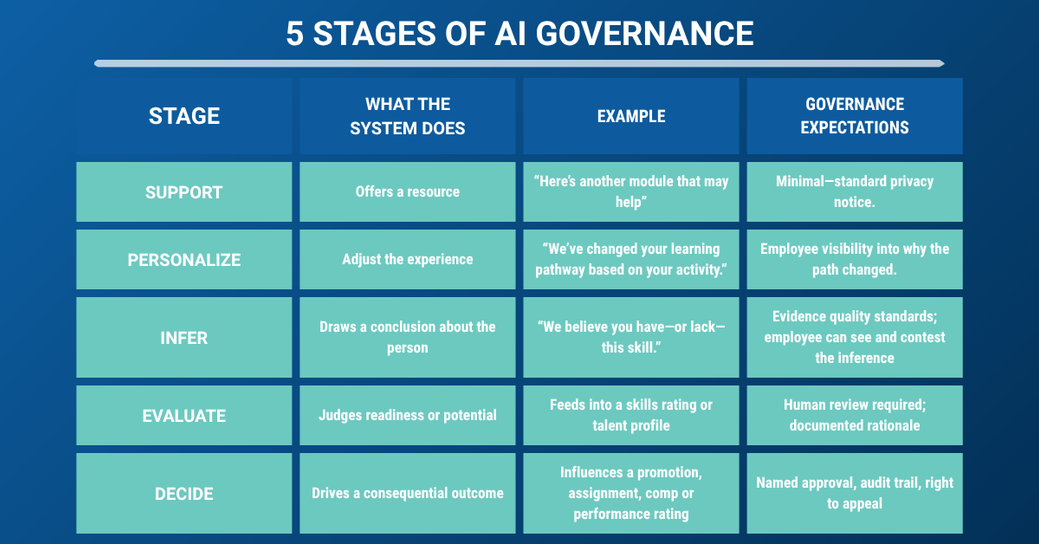
A course recommendation sits at “support” and doesn’t need the same scrutiny as an AI-generated skills assessment feeding a promotion decision at “evaluate” or “decide.” As a working rule: Anything crossing into “evaluate” or “decide” should require a named human approver and a retained record of what evidence was considered—not just a system-generated score.
AI conversations are where this gets personal
AI tutors make this more complicated because people talk to them differently than they would a supervisor. An employee might share: “I don’t understand this. I keep getting this wrong. I don’t think I’m ready to lead a team. I want to move into another kind of role.”
Those can be productive learning moments—we want people to ask those questions. But can the organization see the transcripts? Can the vendor retain them? Can they be analyzed to infer skills, interests or career intentions, and can those inferences move to a manager or another HR system? I don’t think we’ve settled these questions, and learning leaders shouldn’t assume someone else in the organization has settled them for us.
If employees start wondering whether admitting uncertainty to an AI tutor today could affect an opportunity tomorrow, they will adapt, ask safer questions, avoid certain to