Leadership, Talent & 360 Specialists | Hogan Assessments Authorised Distributor UK & Ireland

APS Development Centre

An Advanced People Strategies (APS) Development Centre is typically bespoke to an organisation looking to accelerate the growth of leadership and potential talent. It includes real exercises that simulate typical challenging situations a leader might need to address. Such exercises can offer candidates the opportunity to hone role-specific skills, or experience scenarios they are likely to encounter at the next role level. Exercises may range from managing a difficult interaction with a colleague, direct report or customer to group problem solving and strategic analysis.

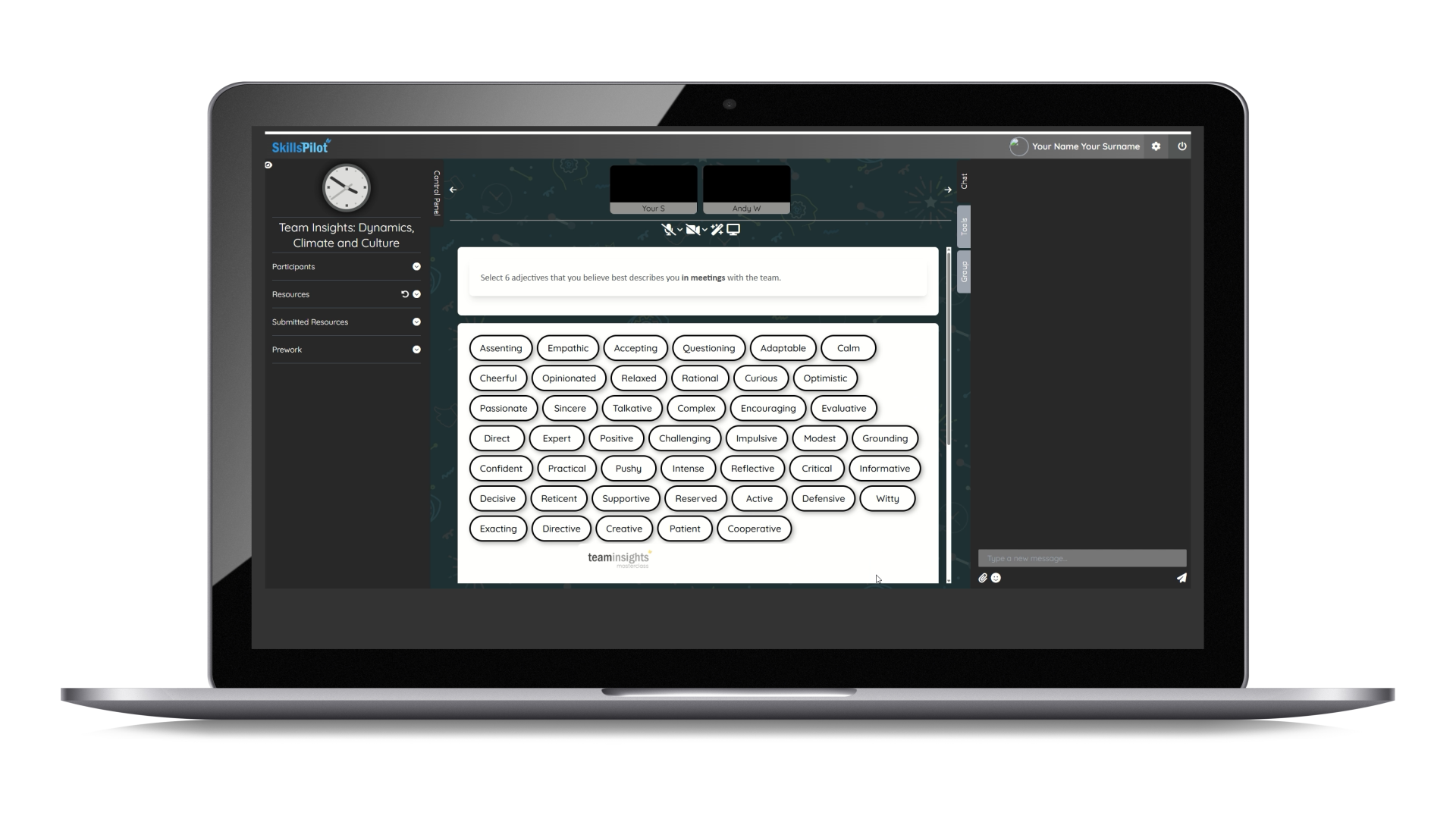
These exercises are typically aligned with an organisation’s skills profile and broader business context. They are observed by a combination of business leaders and APS professionals. Delivery can take place either in person at an organisation’s premises or distributed over time through virtual sessions, similar to standard business meetings, using the APS SkillsPilot platform. This approach enables participation and observation across geographically dispersed teams while often eliminating the need for venue-related costs.

At the end of each exercise, participants assess their own demonstration of skills and this is combined with those from observer assessments and included in a personalised report with actionable development suggestions.

About the Development Centre

Background

Supporting leaders to make decisions - especially those based on an understanding of today’s challenges, possible solutions, and their impact - has become increasingly challenging; much of this capability is being developed in real time, under pressure and urgency.  Each step up in the leadership pipeline typically brings an increase in role scope, broader relationship influence, impact and risk with associated pressure. Building skills through practiced situations can generate confidence, and accelerate experience and readiness.

Insights

An APS Development centre can consist of single or multiple simulated practical situations relevant to a leader's role and level. These simulations can be clustered and experienced in person at an organisation's venue or completed on-line and scheduled like an every-day meeting over any time period - perhaps to blend or evaluate behavioural change resulting from a development or coach programme.

If the DC is virtual and delivered through SkillsPilot, interactions are recorded meaning observers can review exercises at any convenient time anywhere in the world.

media-content

Skills

The APS Development Centre is designed to target and align to an organisations in-house skills and behaviours identified for role and organisational success.   Skills assessed typically reflect those most valued by organisations.

APS consultants work closely with clients to identify priority skill areas. This can be based on existing competency frameworks, organisational values, or tailored to address specific challenges faced by teams or individuals. Skills to focus on are collaboratively decided to ensure high relevance for participants.

media-content

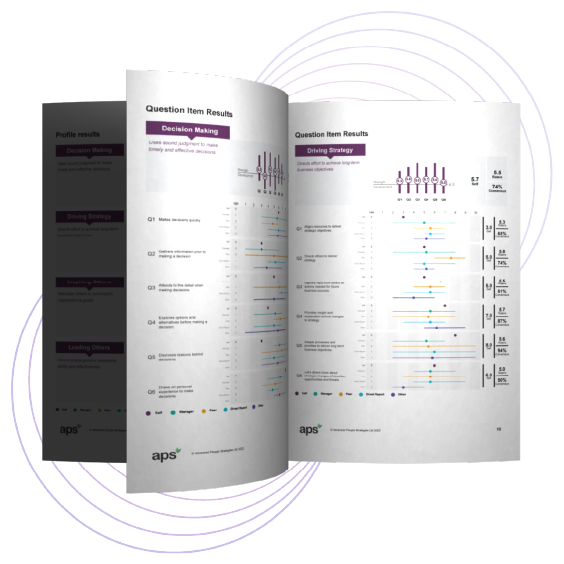
Surveys and assessment tools such as Reflections360 and BEI360 can help pinpoint gaps between how individuals perceive themselves and how others experience working with them. This feedback provides a foundation for choosing which skills would offer the greatest development impact.

media-content

Events

Development centre exercises, often facilitated through SkillsPilot, focus on real-life business simulations. These are tailored to give participants the opportunity to practice specific skills and receive feedback, further cementing areas for focus and development.

Development Centre events can be delivered for individuals, one to one, and as group experiences .  They may involve a range of business simulations or practical exercises.

These experiences are typically designed to reflect real-world business scenarios and support learning in a context relevant to participants’ roles.

Each development experience varies in length: a one-to-one interaction may be as short as 20 minutes, whereas a skills masterclass can be spread over several hours or days.

All events are delivered either in-person or on the APS SkillsPilot platform, offering flexibility for different organisational needs.

media-content

Feedback

Throughout the development centre, observations are gathered by APS-trained assessors. Using SkillsPilot, observers can securely review how participants completed each exercise - online, from anywhere in the world.  In-person observations may require additional time to complete—particularly when multiple exercises are scheduled closely together—and can be finalised offline after the physical centre has closed. To ensure a balanced and well-rounded evaluation, APS assigns different observers across exercises so that each participant benefits from a variety of perspectives. Once all exercise observations are complete, comprehensive centre reports are compiled and made available for feedback.

There is an emphasis on self-reflection, enabling participants to consider their own experiences and feedback received in relation to the targeted competencies or skills.

Participants will be able to evolve their personal development plan, identifying both immediate and longer-term actions to support their ongoing growth as a result of their experience.

APS can provide further coaching or support as needed, ensuring the transfer of learning back to the workplace.

media-content

✅ Align to in-house skills and behaviours identified as critical for success.

✅ Feature business-relevant simulations or scenarios.

✅ Provide detailed observation and multi-source feedback.

✅ Can be flexibly delivered, both virtually and in-person.

Research Perspective

How can organisations turn leadership development into measurable behaviour change?

Research demonstrates that while vast sums are invested in learning and development (L&D)—and frameworks like 70-20-10 remain foundational—completion rates, learning transfer, and true behavioural change are often lacking when programmes are content-heavy, disconnected from day-to-day challenges, or fail to create psychological safety. Several studies highlight critical risks such as “scrap learning” rates as high as 60–85%, persistent skills gaps, low engagement and poor retention among both leaders and wider employees.

According to the broad evidence base, the strongest commercial returns are realised by organisations that embed learning within real work, foster dynamic social and coaching connections, prioritise individual and group motivation, and align L&D tightly with organisational strategy and future skill needs. Research shows that hybrid, cohort-based, or coaching-led models that blend self-directed content, social support, and curated feedback yield significant improvements: higher course completion and skill application, lower attrition, talent pipelines that match business need, measurable productivity gains, and better succession at all organisation levels.

Leading industry experts consistently urge business leaders to fundamentally rethink the purpose and delivery of leadership development and learning. They argue for a decisive pivot to practice-based, experiential, and context-aware learning, where coaching, feedback loops, and real business challenges take centre stage over abstract knowledge transfer or off-the-shelf frameworks. Top practitioners and education innovators are vocal in calling for a blended, “in-action” approach: one that fuses social learning, personal accountability, coaching, and modular experience across all leader levels, with special emphasis on workplace realities, accessibility, and diversity of format. The consensus is that sustainable business impact flows not from content volume but from robust systems that treat leadership as a capability to be practised, reflected upon, and refined in rhythm with real work.

Center for Creative Leadership. The 70-20-10 Rule for Leadership Development. Center for Creative Leadership, 2025.

CIPD. Role of HR in selecting and developing senior leaders. CIPD, 2025.

Cook, M. & Morrow, P. 5 Characteristics of a Successful Leadership Development Strategy & Approach. Center for Creative Leadership, 2026.

Crowley, L. and Zemanik, M. Lifelong learning in the reskilling era: From luxury to necessity. CIPD, 2025.

Kosovich, J.J., Schneider, M.Q., Morrow, P., & Downs, H.A. Format, Motivation & Support Predict Persistence in Virtual Leadership Development. Center for Creative Leadership, 2026.

Osibanjo, R. Why Your Leadership Development Programs Don’t Create Lasting Change And What To Do About It. Forbes, 2023.

Overton, L. Learning at work 2023. CIPD, 2023.

Perna, M.C. Why Learning And Development Is Now A Competitive Differentiator. Forbes, 2022.

Perna, M.C. In The War For Talent, May The Best Learning & Development Cultures Win. Forbes, 2023.

Pontefract, D. Why Learning And Development Is Failing The Business. Forbes, 2025

Puutio, A. The Future Of Leadership Development Is In Practice, Not Theory. Forbes, 2026.

Riddle, D. When In-Person Leadership Training Works Best. Center for Creative Leadership, 2026

Sample Report

Sample reports are available, demonstrating the structure and insights offered without any commitment.

Features :

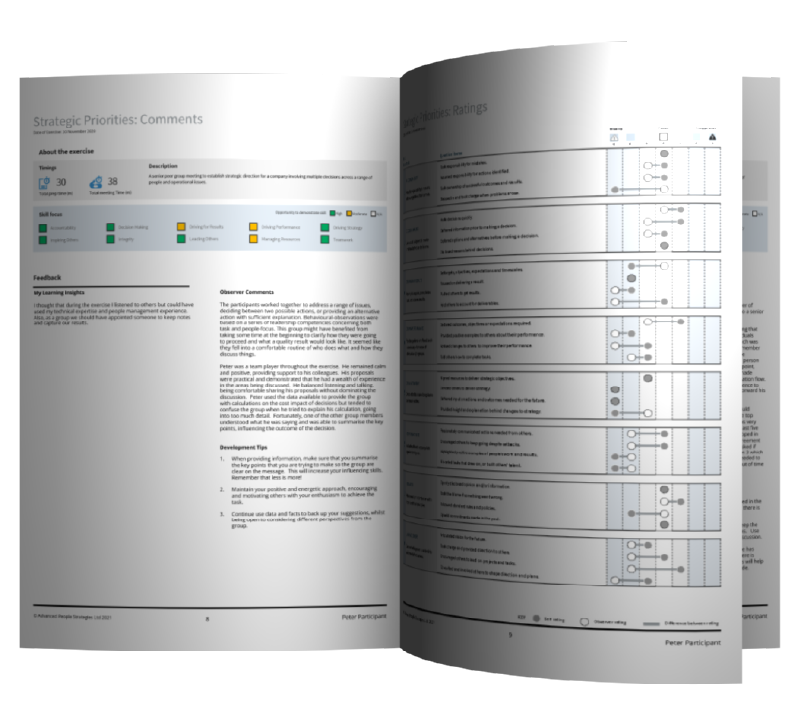
The first section of the feedback report provides an overview of skill ratings based on observer feedback across all exercises. It helps individuals identify trends, strengths, and areas that may need extra attention. There is a focus on prioritising development actions based on whether a skill is underused or overused, using a clear rating scale. The summary allows the participant to quickly spot key behavioural competencies and performance patterns .

Each exercise is reviewed in detail, with specific feedback from both participants and observers. This includes context for each scenario, behaviours demonstrated, and actionable tips for improvement. Skills are scored individually, and any gaps between self-perception and observer feedback are highlighted, encouraging greater self-awareness and alignment between reputation and impact .

Skills are ranked from "missing" or underused to "exaggerated" or potentially overused, providing a behavioural strengths and development needs profile. This helps participants to focus on skills that require development and to moderate any that may be holding them back due to overuse. Extreme overuse is flagged, as it can have adverse effects on workplace relationships .

The final section of the report offers a structured template to create a personal development plan. Participants are encouraged to record specific behaviours to keep, start, or stop, ensuring that development goals are achievable and relevant to both current and future roles. It encourages ongoing tracking and reflection against individual objectives .

media-content

Enquiry Form

Development Centre


skillspilotLogoTM.png
Comp 10.png

SkillsPilot is an advanced platform designed to support Development Centres by providing a structured and interactive way to assess and develop key leadership and business skills in a virtual environment, record events and provide feedback on observable behaviours.

? ? !