Leadership, Talent & 360 Specialists | Hogan Assessments Authorised Distributor UK & Ireland

Trusted Leader

The Trusted Leader Masterclass equips managers at all levels with practical tools and techniques to proactively build individual capability and respond effectively to challenges as they arise, using both proactive and reactive situational coaching skills.

During the workshop participants learn how to provide evidence-based feedback and use advanced communication styles, and an effective approach to structuring productive meeting outcomes. 

Delivered by experienced consultants and professional coaches, it is available both in-person and virtually via the SkillsPilot platform.

media-content
media-content

About the Trusted Leader Masterclass

Background

Participating in the Trusted Leader masterclass provides managers and leaders with the explicit skills and practical techniques to notice, interpret, and act on behavioural trends that are directly linked to broader skills and competencies within their teams.

Through evidence-based feedback and advanced communication methods, leaders learn how to reinforce confidence by recognising and acknowledging positive behaviours, as well as how to use reflective, reactive feedback to explore alternative approaches that could have enhanced outcomes.

The programme’s techniques enable leaders to spot patterns in behaviour—such as how individuals respond to challenges, collaborate, or demonstrate resilience—and connect these trends to key competencies eg. planning and organising, teamwork, problem-solving.

What to Expect

The Trusted Leader Masterclass is a highly practical and engaging development experience, designed to be tailored to your organisation’s unique context and supported by expert coaches. The programme combines interactive plenary sessions with focused small-group coaching, ensuring that learning is immediately translated into practical leadership skills.

Those who take part in the Trusted Leader Masterclass consistently report significant improvements in their ability to influence others, lead open and constructive conversations, and engage proactively with a range of perspectives.  Participants are encouraged to actively practise new techniques, with a strong emphasis on applying these skills to real workplace challenges from day one. 

Over time, these enhanced capabilities help leaders become adept at proactively coaching their teams and building trust, which in turn builds talent and drives higher engagement and productivity.

✅ Proactively build individual capability, trust and confidence.

✅ Provide evidence-based targeted feedback​.

✅ ​Use advanced communication styles appropriate to people situational need​.

✅ Reinforce confidence and belief with individual talent capability​.

✅ Actively build capability to support career development and succession planning​.

Build trusted relationships and accelerate talent development.

Opportunity to reflect with other peers.

Context-driven learning experience.

Research Perspective

media-content

Why is trust in leadership important?

Numerous studies have found that trusted leaders are the key to commercial performance and organisational resilience. Research across the literature indicates that high-trust organisations outperform their peers by encouraging staff involvement, innovation and adaptability, directly impacting profitability and long-term value creation. Evidence consistently shows that trust is built and maintained through genuine, open leadership—rooted in competence, integrity, empathy, and a proven track record of making fair decisions. Leaders who neglect trust risk slow progress, disengagement, and losing talented staff, while organisations that treat trust as a measurable and managed asset set themselves apart—especially in times of complexity, digital disruption, and societal uncertainty.

Research also highlights that trust is not a fixed value but a dynamic, ongoing process kept alive by purposeful actions at every leadership level. The benefits are clear: higher employee retention, customer loyalty, reputational strength, and a culture of psychological safety that helps teams face uncertainty and achieve better results. Conversely, a lack of trust or a failure to address trust breaches leads to reputational risk, poor business performance, and an environment where people disengage. In an era increasingly marked by volatility and doubt, trust in leadership is not only an ethical foundation but a practical, valuable resource that supports growth, adaptation, and long-lasting stakeholder support.

Barends, E., Rousseau, D., Janssen, B., Capezzio, A., & Velghe, C. (2023). Leadership development: An evidence review – Scientific summary. Chartered Institute of Personnel and Development.

Blakey, J. (2025, November 4). If trust is so important, why aren’t we measuring it? Harvard Business Review.

Duncan, R. D. (2021, August 31). Trust: How to earn it, keep it and assess it in others. Forbes.

Duncan, R. D. (2023, September 12). ‘Trust’ may have some nuances you haven’t considered. Forbes.

Duncan, R. D. (2026, February 14). Trust isn’t soft: Why leaders must make it behavioral. Forbes.

Feuer, N., & Mastrogiovanni, M. (2025, December 2). Most employees don’t trust their leaders. Here’s what to do about it. Harvard Business Review.

Frei, F., & Morriss, A. (2020, May–June). Begin with trust: The first step to becoming a genuinely empowering leader. Harvard Business Review.

Frei, F. X., & Morriss, A. (2023, October 3). 10 pitfalls that destroy organizational trust. Harvard Business Review.

Friedman, R. (2024, January 10). How high-performing teams build trust. Harvard Business Review.

Hope-Hailey, V., & Gustafsson, S. (2014). Cultivating trustworthy leaders. Chartered Institute of Personnel and Development.

Ryan, T. (2022, February 7). How business can build and maintain trust. Harvard Business Review.

Sucher, S. J. (2021, June). Author Talks: Sandra J. Sucher on the power of trust. McKinsey & Company.

Sucher, S. J., & Bersoff, D. M. (2025, November 14). How leaders can build stakeholder trust in uncertain times. Harvard Business Review.

Sucher, S. J., & Gupta, S. (2021). The power of trust: How companies build it, lose it, regain it. PublicAffairs.

Tucker, R. B. (2026, February 27). Why building trust matters in the age of acceleration. Forbes.

Wedell-Wedellsborg, M. (2026, March 23). Leaders feel their agency eroding—and they’re starting to withdraw. Harvard Business Review.

The impact of personality and values on Trusted Leader relationships

Personality Impact

The Trusted Leader Workshop explores the impact of personality on forming and maintaining business relationships. Participants receive a personal Hogan Assessment report outlining the strength of their values and how they compare to other working adults around the world.

If your team/group members have recently completed the Hogan Personality Assessments participants can utilise these additional insights during this Trusted Leader Masterclass.

Key Takeaways

  • Evidence-based frameworks tailored to real-world contexts.

  • Personal and group skills practice with dedicated expert coaching.

  • Tools and insights that encourage reflective practice and practical application.

  • A collaborative environment that enables peer learning and builds lasting confidence.

media-content
tl-logo.svg
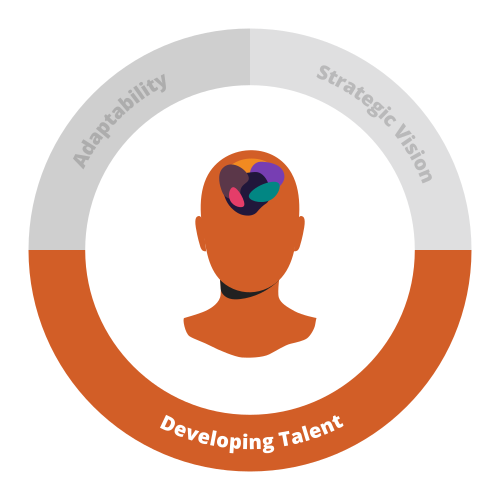
TL-devTalent-outlined.svg

The Trusted Leader Masterclass runs as a complete package, including set-up logistics and all participant materials. Feedback from past attendees highlights the straightforward pre-course preparation and the immediate, practical relevance of every session.

? ? !