

Organizations want employees to be creative problem-solvers, yet training environments can unintentionally mimic business pressures that push learners toward rapid solutions.
This tendency undermines the ability to teach a truly necessary capability: deep, creative problem-solving. It seems paradoxical, but effectively teaching the skills to creatively problem-solve requires insulating learners from the pressure to rapidly meet business needs. At least, for a while.
Before we dive deeper into this preposterous statement, let’s start by differentiating between traditional problem-solving and creative problem-solving.
Traditional problem-solving is typically analytical and linear: You define a problem clearly and find the best answer from tried-and-true options. On the other hand, creative problem-solving is a broader approach. It asks you to reframe the problem, generate many possible responses and consider unconventional ideas.
Both approaches serve a purpose, but creative problem-solving is needed for exceptionally difficult issues.
So, can this be taught?
The “creative” in creative problem-solving is often viewed as a black-box mystery ingredient that stops people from believing they could develop this capability themselves. Sometimes, it even stops organizations from believing they could effectively increase this capability through their training efforts.
The solution lies in a strange place: play.
Not unrestricted anarchy, but the freedom to step away from business needs long enough to provide unrestricted possibility.
If this still seems unteachable, let’s get into the components necessary to deconstruct creative problem-solving and assemble them into a framework for transferring this elusive skill to your workforce. But first, we need to address a misconception of creativity.
People often use “creative” as an adjective to describe someone. The truth is that they are ascribing creativity to a person when what they are really experiencing is the emotion that the person elicited. Here is a simple example.
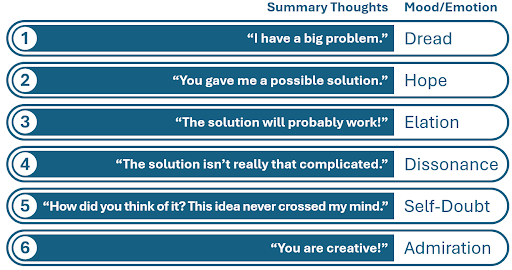
But creativity is more than an emotional impression, and problem-solving is not merely magic. They are the result of well-practiced skills. Our unintentional focus on the impact of creative problem-solving over how it is done can obscure how we approach it as a learning function.
We can teach this capability by first deconstructing it to provide actionable focus for our craft. The primary skills for creative problem-solving fall into the following categories:
- Recognition of cause vs. symptom (accurate problem definition)
- Recall of past experiences (drawing on analogous situations)
- Paradigm-floating (the ability to combine disparate concepts to generate new possibilities)
Our role as leaders is to successfully train on these different components. And we can truly accelerate adoption of this skill if we teach it in a low-consequence environment that does not punish being wrong—an environment that promotes a foundation of curiosity before, during and after the learning experience.
Learning functions can design development programs that:
- Deconstruct creative problem-solving into distinct skills.
- Target each skill directly with exercises and spaced repetition.
- Create low-consequence practice environments that reward exploration.
- Build ongoing, real-world practice into daily workflow after the initial learning event.
4 actions to deliver creative problem-solvers that multiply
Traditional problem-solving aims to fix a known problem efficiently, whereas creative problem-solving aims to discover new or better ways to solve issues. If that is the aim, then it stands to reason that creative problem-solving would require unique up-front design work and, possibly, the creation of a specific learning environment.
Deconstruct creative problem-solving into distinct skills. Creative problem-solving is not the innate talent it is often made out to be. Creative problem-solving can be taught by breaking it into core components. The primary skills are clustered into three distinct categories. Each category poses a unique challenge to L&D professionals.
Recognition of cause vs. symptom (accurate problem definition). It is difficult to create training experiences that allow space for resistance long enough to ensure that the right problem is being solved. This is understandable, since creative problem-solving puts a great deal of pressure on achieving an actual solution to the problem at hand. Unfortunately, this adds pressure that undermines the very capabilities needed to deliver results.
Humanity is great at solving problems. Unfortunately, we are not very good at identifying the problem that needs to be solved. Russell L. Ackoff said it best: “We fail more often because we solve the wrong problem than because we get the wrong solution to the right problem.”
We tend to assume that the problem is obvious, and we move forward as though this obvious problem is already well-defined. It is neither. One of the unheralded benefits of creative problem-solving is that it starts by openly questioning if the problem has been framed correctly.
Recall of past experiences (drawing on analogous situations). Traditional problem solving is often linear; creative problem solving is more iterative and exploratory. It moves fluidly through clarifying, ideating, developing and implementing. Layering this fluid thinking on top of relevant past experiences is a powerful device. Knowing what has worked (or didn’t work) in the past can create a launching pad into resolving current issues.
Randy Pausch is a big fan of the power of learning from past experiences. In his book, “The Last Lecture,” he coined the phrase: “Experience is what you get when you don’t get what you want.”
Paradigm-floating (the ability to combine disparate concepts to generate new possibilities). Traditional problem-solving tends to stay within established methods, while creative problem-solving welcomes unconventional ideas and multiple possible solutions. A good example of this can come from recalling past experiences. A creative problem-solver might not have any experience to draw on in a given situation, but they could still apply lessons learned from experiences obtained in vastly different industries.
Bringing unrelated solutions togeth