
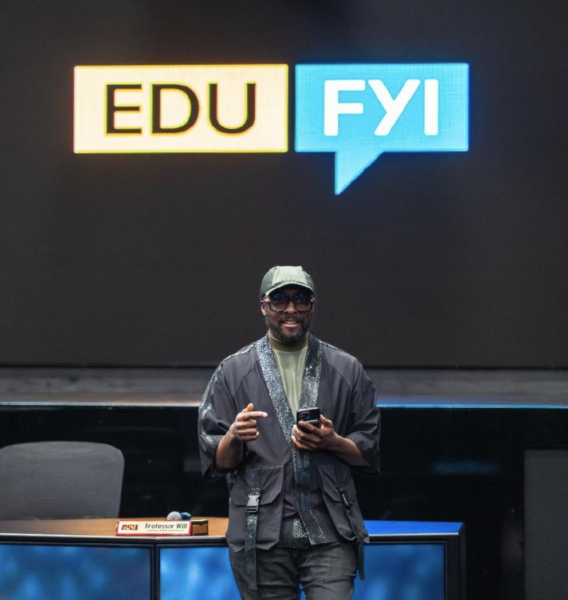
I was in the room where it happens. I was part of the first cohort of Arizona State University’s The Agentic Self course, something will.i.am (the front man for the hip-hop group Black Eyed Peas) and ASU imagined in 2025. Professor Will, as we called him, had already created the FYI campus in Hollywood: a magical hip-hop version of Willy Wonka’s factory, but instead of chocolate bars, it manifests music, products and now … people empowered to build in an AI world to make a better real world.
As he worked with the ASU president and professors, Professor Will reimagined and transformed a space at the FYI campus into a room for learning and collaboration. The room was designed in a U-shaped format modeled after the United Nations, with each person having their own chair and microphone, which matters when virtual guests are part of the conversation.
Being in that room changed how I think about agency, curiosity and what it means to stay human-led in a world of AI agents. And it raised a question I have not been able to stop thinking about: What if organizations created the conditions for their people to have that same experience?
“Agentic self is you claiming your data and now putting it to work for you by creating an agent that reflects your beliefs, your concerns, your passions, your interests.” — will.i.am on NBCLA
What the room taught me
What I learned in that room, and through the course itself, is that you rarely know what a spark can do until you move it through different environments. The room, the people, the platform and the context all shape what becomes possible.
That’s why exploration is not a side quest; it is part of the build. In a world shifting this fast, curiosity is a capability, and courageous curiosity is one way we stay human-led. Let me share with you my story.
A spark that started it all
My idea started two years ago, when most people were talking about large language models (such as ChatGPT) as a way to become more efficient and productive. As a learning innovation professional, I saw something else: the possibility that these AI tools could not only transform how people learn about hard conversations, but how they practice and prepare for them.
That insight became the seed for a conversational skill builder. It is a way for people to practice real scenarios, receive immediate, personalized feedback, and then have guided reflection to gain insights for lasting transformation.
ChatGPT was the first place I explored it, because I wanted to know whether the idea had legs and could actually work. That first step was not the whole solution. It was the beginning of moving from idea into action.
The evolution of my idea across AI platforms
What started as a conversational skill builder in ChatGPT kept evolving as I moved it across platforms, each one revealing something new about what the idea could do.
In ChatGPT, as a learning innovator for my own curiosity, I could test the concept on my own and see whether the core interaction worked and was useful.
In Copilot Studio at Providence St. Joseph Health, as manager of learning innovation for a large healthcare system, I was trying to solve a different problem: how to author and deploy this idea at enterprise scale, inside the real constraints of organizational complexity, governance and strategic alignment.
In Acolyte, as a strategic innovation consultant for a small AI startup, I worked on this idea on their platform to easily author multimodal experiences and include avatars, opening up a richer learning experience.
And in FYI, the idea transformed again. What I found was a confirmation of something I had been building toward: an easy-to-use platform with a different set of tools and capabilities that let me move beyond a skill builder and evolve into a more personalized, guided, action-based learning experience. What crystallized here was a principle I had been circling for some time: What AI makes genuinely possible for learning and performance support is in a middle ground that has not yet been fully claimed. It is not the open-ended blankness of an empty AI prompt, which can overwhelm as easily as it empowers. And it is not the rigidity of a static PDF, a traditional course or a fixed video. It is something in between — an adaptive, scaffolded support that guides without constraining and that gives the person both structure and room to move.
That was the big surprise in the journey — not that the idea worked, but how much further it could go: from a skill builder to the concept of AI-guided mastery.
It confirmed what I had believed from the beginning: The same core spark blooms differently depending on the environment it enters. ChatGPT gave me a first test. Copilot Studio revealed the friction of enterprise-scale authoring. Acolyte showed what easy multimodal authoring could unlock. FYI showed me that the idea could become something more expansive — not just a learning tool, but AI-guided mastery through a collaborative environment. People engage through their own personally configured persona to have deeper discussions and explore guided activities so they can move from spark to action.
This is the deeper truth I want to share: When you hold an idea and keep moving it through different environments, you discover not just what it can do, but what it was always meant to become. That is what exploration really is. That is what innovation really is. And that is why curiosity is not a nice-to-have in a fast-shifting world — it is essential for success.
What this means for leaders
For leaders, founders and executives, this matters because best fit chan