Leadership, Talent & 360 Specialists | Hogan Assessments Authorised Distributor UK & Ireland

An Introduction to the Motives, Values Preferences Inventory

Discover what drives performance from within. The MVPI explores the underlying values and motivations that shape workplace culture, influence decision-making, and determine long-term engagement. Here you’ll see how understanding values—in yourself or your people—can support fit, fulfilment, and business success as part of a wider talent strategy.
How Values Influence Behaviour and Performance.

media-content

Values serve as a compass, guiding how individuals prioritise, relate, and respond at work. They filter day-to-day choices, shape attitudes toward change or collaboration, and create the context in which people feel truly motivated. Unlike skills or traits, values are about what people feel is most rewarding or meaningful—so aligning these with organisational culture is essential for building cohesion, discretionary effort, and retention. Misalignment, by contrast, can be a root cause of disengagement or friction.

The MVPI helps organisations move beyond surface-level fit by clarifying what energises people and the team cultures leaders are likely to foster. There are no “right” or “wrong” values—only the question of whether a personal or team preference fits the needs and direction of the business.

Leadership

The Motives, Values, Preferences Inventory (MVPI) surfaces the core drivers that shape how people lead, communicate, and set the tone for those around them. By understanding these motivational patterns, organisations can build leadership teams with authentic influence and aligned direction.

Specifically:

Predicting Leadership Culture

The MVPI helps you see the type of environment a leader will build—whether fostering competition, teamwork, creativity, or stability—and how these priorities mesh with organisational goals.

Anticipating Motivational Fit

Gain a clearer sense of what will inspire or frustrate an individual leader. The MVPI can flag where mismatches between role or culture and personal values might lead to disengagement, resistance, or turnover.

Guiding Meaningful Development

Use values insights to shape personal and group development plans. By tapping into what truly motivates people, coaching and talent programmes can be tailored for greater sustainability and impact.

Hogan Personality Inventory Scales

media-content

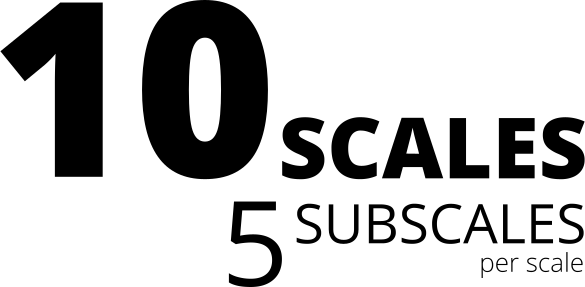
The MVPI provides a detailed assessment across 10 main scales and 50 subscales, each representing drivers of human motivation.  This comprehensive profile uncovers the beliefs and priorities that guide how an individual approaches work, interacts with others, and makes decisions.  By focusing on values rather than abilities or personality traits alone, the MVPI offers organisations practical insights for predicting cultural fit and understanding what will inspire satisfaction and commitment in a wide range of business contexts.

Drag the sliders below to take a look at how this may play out for low and high scorers.

Scale
Score
Low High
Value/Prefer
Recognition
Move slider to see point information
Power
Move slider to see point information
Hedonism
Move slider to see point information
Altruistic
Move slider to see point information
Affiliation
Move slider to see point information
Tradition
Move slider to see point information
Security
Move slider to see point information
Commerce
Move slider to see point information
Aesthetics
Move slider to see point information
Science
Move slider to see point information

Talent Acquisition

When it comes to talent acquisition, the MVPI provides hiring managers with a deeper understanding of what truly motivates each candidate. By examining the alignment between personal values and organisational culture, the MVPI offers key insights into how new hires may engage, influence, and thrive— or where they may find challenges—once in role.

For Example:

Candidates high in both recognition and power are likely to seek visibility and influence. In high-profile, fast-paced environments, this drive can accelerate ambition and motivate achievement. However, in cultures that reward humility or collective input, this combination may create tension or competition for attention.

Those motivated by power but less by affiliation may focus on achieving results and setting direction, with limited emphasis on collaborative harmony or relationship-building. This can suit roles requiring independent leadership or rapid decision-making, but could be less effective in organisations where team connection and consensus are central to success.

Applicants with low affiliation but high commerce are typically energised by results and the pursuit of tangible business goals, often preferring transactional interactions over building close-knit teams. This can be ideal for sales-driven or highly competitive environments, but may pose challenges in cultures where community, support, and long-term relationships are vital.

Talent Development

The MVPI enables organisations to tailor development strategies to what truly matters to leaders and teams.

By surfacing both motivating and potentially conflicting values, organisations can:

  • Shape coaching or mentoring around what drives (or demotivates) the individual.

  • Guide career conversations to help leaders discover where their values will support personal growth, or where they may need to stretch to match changing organisational priorities.

  • Plan development sessions that use team values to spark engagement, navigate value clashes, or address gaps in motivation.

For Example:

Leaders high in recognition but low in altruism may be driven by personal success and a desire for acknowledgement, sometimes placing their own advancement ahead of team wellbeing. Development plans can focus on cultivating empathy and building an awareness of the impact of individual achievements on broader group morale and retention.

Individuals valuing security but less focused on altruism often seek predictability and clear structures, with less emphasis on supporting others. This can stabilise teams during change, but might limit participation in or support of initiatives that require flexibility or personal investment in others’ development. Coaching can help such leaders balance the need for security with selective openness to growth and contribution.

Leaders high in both security and science tend to value order, process, and evidence-based decision-making. They may bring a methodical, systematic approach to problem-solving, but could be slower to adapt when situations call for ambiguity or bold innovation. Development sessions might explore ways to build adaptive thinking while honouring their need for structure and accuracy.

Implementation

Initial Administration: Participants complete a standardised questionnaire that explores various facets of their personality, focusing on their optimal functioning.

Available to take on desktop or mobile, in more than 40 languages.

Analysis & Scoring: Responses are systematically evaluated against established scales, with individual strengths and development areas identified. This analysis is then synthesised into detailed personality profiles that indicate how well an individual's attributes align with specific job requirements and the broader organisational culture.

Interpretation & Application: HR professionals and talent specialists—often with support from the Hogan Certification Workshop—translate these profiles into actionable insights, informing recruitment decisions, development plans, and succession strategies.

Hogan Certification

To be able to administer and interpret the Hogan Personality Inventory, you will need to complete the Hogan Certification process.  Find out more on the Hogan Certification page. 

media-content
aps-hoganAD.svg
hogancert-icon.svg

Official Hogan Certification Workshop.

2-Day workshop, for people who are new to the Hogan tools, and would like to start using them.  Run in-person, virtually or in-house.

? ? !