Leadership, Talent & 360 Specialists | Hogan Assessments Authorised Distributor UK & Ireland

An Introduction to the Hogan Personality Inventory

Explore the interplay between personality and performance.  Here you will encounter one perspective on how personality insights - illustrated by the HPI - might be considered within the wider talent strategy. 
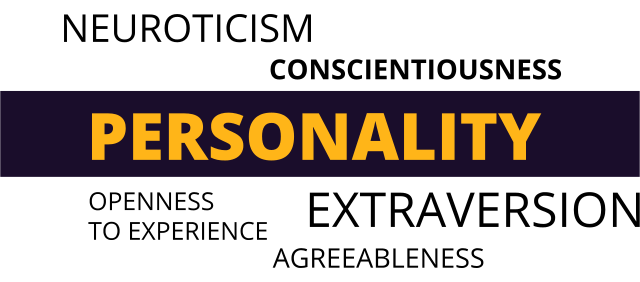
The Relationship between Personality and Performance.

media-content

Personality attributes refer to the enduring traits that shape an individual’s behaviour, emotions, and thought processes. Frameworks like the Big Five personality traits (Openness, Conscientiousness, Extraversion, Agreeableness, and Neuroticism) are frequently used by researchers and practitioners to map these attributes.

Each trait contributes uniquely to work behaviours, from decision-making to problem-solving, influencing how individuals interact with colleagues and manage tasks.

Leadership

The Hogan Personality Inventory is a widely utilised tool that evaluates normal personality characteristics most relevant to career success. Unlike assessments that merely label deficits, the HPI is designed to identify strengths and potential areas for development, linking personality traits with leadership effectiveness and job performance.

Specifically:

Predicting Leadership Style

Unlock insights into how a leader naturally motivates, guides, and interacts with their team. The HPI reveals behavioural tendencies, helping organisations match leadership styles to the demands of their roles.

Anticipating Challenges

Gain a clear view of which behaviours may support or hinder future success. The HPI helps to anticipate challenges by revealing how personality traits align—or clash—with key aspects of a leader’s role, team dynamics, and organisational culture.

Enhancing Development

Turn self-awareness into growth. The HPI predicts a participant's natural behaviour that others are likely to experience in the workplace day-to day i.e. their "reputation".  Such information can offer insights into what is likely to be a natural skill that leads to job role performance as well as areas that may take more effort to manage effectively.

Hogan Personality Inventory Scales

media-content

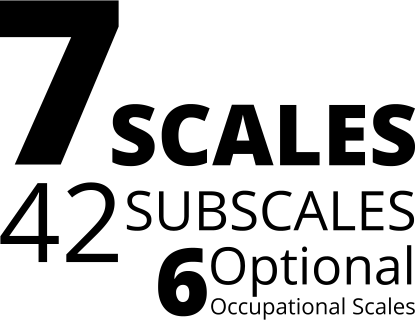
The HPI delivers an in-depth look at 7 main scales and 42 subscales. This comprehensive profile aids in understanding the nuanced ways an individual might behave, offering invaluable data that can predict future work performance and leadership capability.  Its focus on normal personality attributes—rather than extreme or pathological traits—means that the HPI is particularly well-suited for everyday business applications.

Drag the sliders below to take a look at how this may play out for low and high scorers.

Main Scale
Score
Low High
Has a reputation of being:
Adjustment
Move slider to see point information
Ambition
Move slider to see point information
Sociability
Move slider to see point information
Interpersonal Sensitivity
Move slider to see point information
Prudence
Move slider to see point information
Inquisitive
Move slider to see point information
Learning Approach
Move slider to see point information

Talent Acquisition

When it comes to talent acquisition, the accuracy and depth of the HPI provides hiring managers with actionable insights. By evaluating candidates’ normal personality characteristics, the HPI helps predict how well they might integrate into the existing organisational culture and cope with routine business challenges.

For Example:

Candidates who are high on adjustment but low on ambition are likely to appear steady and calm, often comfortable supporting others rather than stepping into the leadership spotlight. This combination may bring much-needed stability to a team navigating constant change or uncertainty, but might be less suited to roles where assertive leadership and proactive goal-setting are central to success.

Candidates who are low on ambition but high on inquisitive are likely to contribute original ideas and enjoy exploring new concepts, yet may show less inclination to take the lead or steer team direction. This combination may benefit teams seeking innovative input and diverse perspectives, especially where leadership is shared or specialist expertise is valued, but could be less effective in roles that call for setting vision and actively guiding others.

Candidates who are high on inquisitive but low on learning approach tend to generate novel ideas and enjoy tackling new problems, but may be less consistent in seeking out or applying formal training. In a leadership context, this combination may suit environments that value unconventional thinking and adaptability, though it may present challenges in roles where systematic learning or knowledge sharing is key to team success.

Talent Development

In the realm of talent development, the detailed insights provided by the HPI can be used to tailor personal development programmes. By identifying strengths and areas that need refinement, organisations can:

  • Develop mentorship and coaching plans that are personalised to the individual.

  • Facilitate career progression conversations with a solid, evidence-based foundation.

  • Organise team training sessions that build on inherent strengths.

Individuals with high adjustment and low sociability usually appear calm and steady under pressure, but may contribute less to team discussions or avoid connecting widely across the organisation. For leaders in technical or specialist functions, targeted coaching might focus on strengthening cross-functional relationships—supporting effective collaboration and visibility when driving multi-team projects or organisational change.

Leaders low in sociability but high in interpersonal sensitivity build strong, trusting one-to-one relationships and readily offer support to colleagues. However, they may prefer to avoid group interactions and could find it challenging to address sensitive issues directly in larger forums. Career progression conversations might focus on developing greater confidence in navigating group settings and leading transparent team communication.

A team of leaders high in both interpersonal sensitivity and prudence is likely to foster cooperation, reliability, and a respectful culture where standards are carefully upheld. For team development, sessions could focus on building confidence in navigating constructive conflict and encouraging open-mindedness—helping the group feel comfortable challenging assumptions and adapting processes when needed.

Implementation

Initial Administration: Participants complete a standardised questionnaire that explores various facets of their personality, focusing on their optimal functioning.

Available to take on desktop or mobile, in more than 40 languages.

Analysis & Scoring: Responses are systematically evaluated against established scales, with individual strengths and development areas identified. This analysis is then synthesised into detailed personality profiles that indicate how well an individual's attributes align with specific job requirements and the broader organisational culture.

Interpretation & Application: HR professionals and talent specialists—often with support from the Hogan Certification Workshop—translate these profiles into actionable insights, informing recruitment decisions, development plans, and succession strategies.

Hogan Certification

To be able to administer and interpret the Hogan Personality Inventory, you will need to complete the Hogan Certification process.  Find out more on the Hogan Certification page. 

media-content
aps-hoganAD.svg
hogancert-icon.svg

Official Hogan Certification Workshop.

2-Day workshop, for people who are new to the Hogan tools, and would like to start using them.  Run in-person, virtually or in-house.

? ? !