Leadership, Talent & 360 Specialists | Hogan Assessments Authorised Distributor UK & Ireland

An Introduction to the Hogan Development Survey

Uncover the impact of personality risks on workplace performance. Here you will explore how insights from the HDS can inform your approach to identifying, understanding, and managing behavioural tendencies that may challenge long-term leadership success within a broader talent strategy.
The Impact of Derailers on Workplace Performance

media-content

The HDS explores those personality tendencies that may surface under stress or pressure and can disrupt effective working relationships. Drawing on established personality theories, the HDS groups these behavioural risks into practical themes that illustrate how individuals manage workplace challenges. By identifying these patterns, leaders and teams gain insight into how derailers may influence team dynamics, decision-making, and reputation within their organisation.

Leadership

The Hogan Development Survey (HDS) illuminates the personality patterns that can undermine effectiveness in leadership roles, especially during periods of stress or high demand. With this insight, organisations can make informed people decisions and invest in the right support for future and current leaders.

Specifically:

Anticipating Leadership Fit

Incorporate HDS insights into your selection or promotion process to better understand how a candidate’s risk tendencies might align—or clash—with the unique pressures of the role and your organisation.

Understanding Teams Under Pressure

See how existing leaders or teams are likely to react when the stakes are high or environments change. The HDS clarifies which risk patterns could affect communication, influence, or group dynamics when routines are disrupted.

Mitigating Risk

Use HDS results to shape meaningful development actions, from targeted coaching to tailored feedback. By addressing derailers directly—such as tendencies toward micromanagement, avoidance, or defensiveness—organisations can support leaders in managing their impact and navigating complex situations more effectively.

Hogan Development Survey Scales

media-content

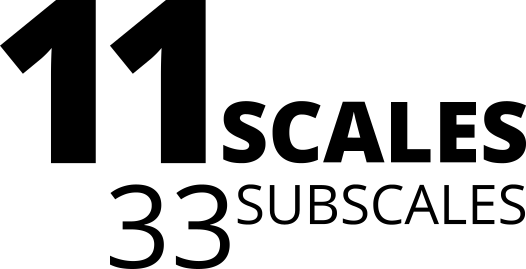
The HDS delivers an in-depth look at 11 main scales and 33 subscales. This comprehensive profile aids in understanding the nuanced ways an individual might behave under pressure or when complacent, offering invaluable data that can predict future work performance and leadership capability.  Its focus on darkside personality attributes—rather than extreme or pathological traits—means that the HDS is particularly well-suited for business applications.

Drag the sliders below to take a look at how this may play out for low and high scorers.

Scale
Score
Low High
Has a reputation of:
Excitable
Move slider to see point information
Sceptical
Move slider to see point information
Cautious
Move slider to see point information
Reserved
Move slider to see point information
Leisurely
Move slider to see point information
Bold
Move slider to see point information
Mischievous
Move slider to see point information
Colourful
Move slider to see point information
Imaginative
Move slider to see point information
Diligent
Move slider to see point information
Dutiful
Move slider to see point information

Talent Acquisition

When it comes to talent acquisition, the accuracy and depth of the HDS provide hiring managers with actionable insights. By evaluating candidates’ darkside personality characteristics, the HDS helps predict how well they might integrate into the existing organisational culture and cope with routine business challenges.

For Example:

Candidates high on both excitable and sceptical may enter new roles or projects with enthusiasm, but over time could lose motivation and become critical if they experience setbacks or perceive insufficient support. This may surface as persistent questioning, reacting strongly to disappointments, or withdrawing when challenges arise—potentially unsettling team stability in organisations that depend on adaptability and steady encouragement. While this vigilance helps identify underlying issues early, it may be less effective in roles that demand ongoing positivity and resilience.

Those high in sceptical and low in boldness may pay close attention to potential pitfalls and prefer to weigh options carefully before acting. Over time, this can look like offering thoughtful caution but holding back from openly challenging direction or stepping forward to drive decisions. This combination may be helpful in settings where careful analysis and consensus are valued, but may present challenges in environments that rely on leaders who readily take initiative or champion new ideas in front of others.

Someone low in boldness and high in dutifulness tends to stay behind the scenes, supporting authority and established practices. Over time, as routines and expectations become clear, this can lead to excessive deference, reluctance to accept ownership, or avoidance of difficult decisions—characteristics that may limit effectiveness in fast-evolving or self-directed environments, but could support consistency and cohesion in more structured teams.

Talent Development

The Hogan Development Survey (HDS) helps organisations personalise development strategies by highlighting risk tendencies that may surface under pressure or as roles evolve.

By understanding these patterns, organisations can:

  • Design coaching and mentoring plans that address specific derailers.

  • Support candid career conversations focused on long-term growth.

  • Plan targeted team sessions to address common risk areas and build collective strengths.

For Example:

Leaders high in excitable but low in cautious may launch into new projects with optimism and urgency but can react sharply to disappointments, sometimes making spur-of-the-moment decisions without pausing to weigh risks. Unlike those who are also high in cautious, they may be less likely to hold back or overanalyse before acting—leading to rapid shifts in team direction or mood. Development conversations may focus on helping these leaders build skills for pausing and reflecting under pressure, so enthusiasm doesn’t quickly give way to frustration or abrupt pivots when facing obstacles.

A team of leaders low in cautious and high in mischievous is likely to embrace bold opportunities, enjoying experimentation and a willingness to take risks. However, under pressure or during high-stakes decisions, this group may overlook important details or act impulsively—potentially exposing the team to unnecessary risk. Team development sessions might focus on embedding collective checks and balances, fostering open dialogue about risk impact, and establishing frameworks to balance innovation with accountability in critical moments.

Leaders with both high mischievous and high diligent scores may demonstrate adaptability and quick thinking in some situations, and intense attention to detail or rule-following in others, depending on who is watching or what is at stake. Development plans should support these leaders to recognise when they're shifting between charm-driven risk-taking and perfectionism, and to develop strategies for remaining consistent and transparent, especially when expectations from different stakeholders collide.

Implementation

Initial Administration: Participants complete a standardised questionnaire that explores various facets of their personality, focusing on their darkside traits.

Available to take on desktop or mobile, in more than 40 languages.

Analysis & Scoring: Responses are systematically evaluated against established scales, with individual strengths and development areas identified. This analysis is then synthesised into detailed personality profiles that indicate how well an individual's attributes align with specific job requirements and the broader organisational culture.

Interpretation & Application: HR professionals and talent specialists—often with support from the Hogan Certification Workshop—translate these profiles into actionable insights, informing recruitment decisions, development plans, and succession strategies.

Hogan Certification

To be able to administer and interpret the Hogan Development Survey, you will need to complete the Hogan Certification process.  Find out more on the Hogan Certification page. 

media-content
aps-hoganAD.svg
hogancert-icon.svg

Official Hogan Certification Workshop.

2-Day workshop, for people who are new to the Hogan tools, and would like to start using them.  Run in-person, virtually or in-house.

? ? !